Introduction: A High-Stakes G20 Summit in South Africa
The G20 Summit in Johannesburg drew a worldwide spotlight as world leaders convened to discuss crucial global problems that ranged from financing climate change to emerging nations’ development aspirations. In his remarks at the start, South African President Cyril Ramaphosa highlighted that the country’s goal was to maintain the G20’s integrity and prestige while also ensuring that the views of the Global South were well reflected.
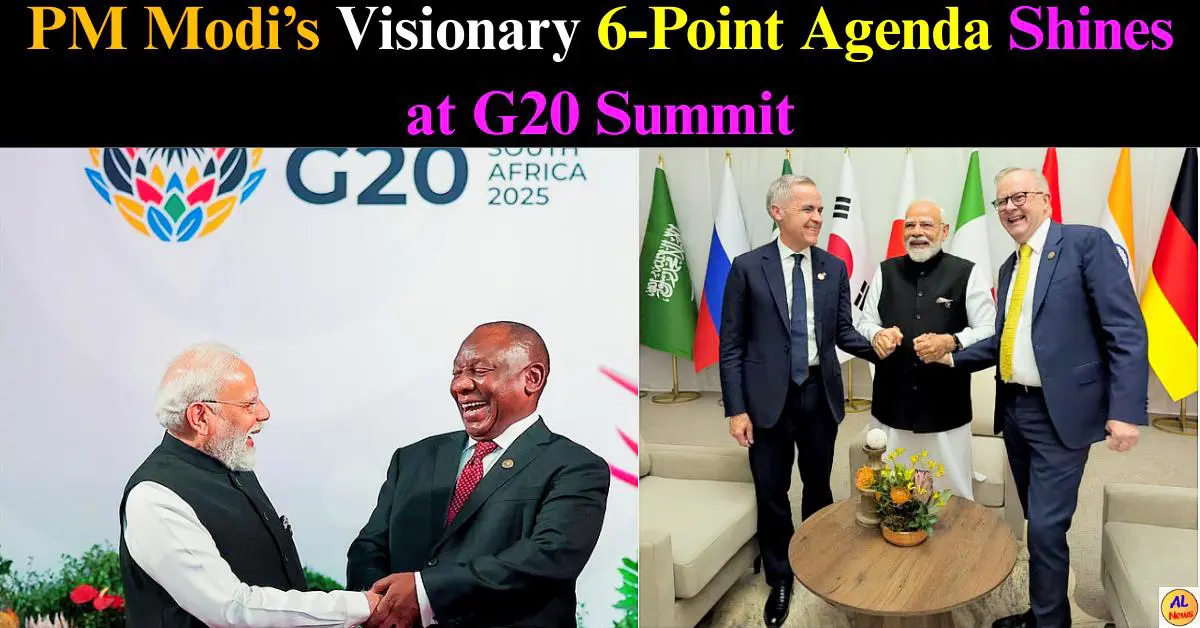
Prime Minister Narendra Modi came a day before the summit and immediately began conversations with numerous global leaders, demonstrating India’s proactive strategy for influencing the global agenda. As the three-day summit progressed, a number of noteworthy developments occurred, including Prime Minister Modi’s six-point program, a big global announcement, and a political dispute surrounding the United States.
Here are the biggest takeaways from the G20 Summit.

G20 Summit: PM Modi Presents a Comprehensive Six-Point Agenda
One of the major highlights of the summit was Prime Minister Narendra Modi’s detailed six-point proposal aimed at strengthening global cooperation.
- Tackling Drug Trafficking with Global Action: PM Modi proposed a G20 Summit Initiative to Combat the Drug-Terror Nexus, urging for immediate and coordinated measures among member countries. His concentration was on how drug trafficking fuels terrorism and destabilizes civilizations.
- A Global Healthcare Response Team: The Prime Minister proposed developing a G20 Global Healthcare Response Team made up of certified healthcare providers who can be promptly deployed during health emergencies, citing lessons learnt from the COVID-19 pandemic.
- Africa-Skills Multiplier Initiative: PM Modi emphasized support for the host continent and proposed a G20 Africa-Skills Multiplier Initiative to help Africa’s workforce evolve and improve its skills.
- Global Traditional Knowledge Repository: He recommended building a global database to conserve traditional knowledge and native customs, particularly in herbal medicine, agriculture, and sustainable living.
- G20 Open Satellite Data Partnership: This effort seeks to provide access to satellite data for natural catastrophe predictions, climate monitoring, and agricultural planning.
- Critical Minerals Circularity Initiative: Recognizing the global scramble for rare earth resources, Prime Minister Modi proposed for a circular economy framework that guarantees the sustainable and equitable usage of essential minerals.
With these ideas, India reinforced its position as a country that promotes innovation, development, and cross-continental collaboration.

G20 Summit Issues Declaration Amid US Boycott
One of the summit’s most dramatic moments was the approval of the G20 declaration without the involvement of the United States. President Donald Trump ordered the boycott after alleging that South Africa was supporting discriminatory practices, which ignited a global discussion.
According to US officials, South Africa did not facilitate a smooth presidency transition and pushed ahead with the declaration despite American objections. This rare diplomatic rift set the stage for intense discussions across the G20 summit.
Despite the controversy, the declaration was approved on Day 1 and highlighted a number of global concerns, including climate change, vital minerals, and sustainable development.
Critical Minerals Framework Gains Spotlight
The G20 Critical Minerals Framework was a prominent highlight of the summit declaration, with the goal of assuring the fair and sustainable use of minerals required for energy from renewable sources, electronics, and innovative technology.
The framework emphasizes:
- Supporting mineral-rich countries (mainly in the Global South)
- Promoting fair value addition
- Reducing underinvestment
- Encouraging technology transfer
- Addressing socio-economic and environmental challenges
This program could help shape the development of electric automobiles, battery technologies, and renewable energy solutions.
Urgent Need to Scale Up Climate Finance
With the COP30 climate discussions wrapping up just days before, climate action grabbed top stage during the G20 Summit. The declaration emphasized the need to expand global environmental finance from billions to trillions, particularly for developing countries.
Key points included:
- Support for Africa’s energy transition
- Investment in sustainable infrastructure
- Focus on early warning systems for climate-linked disasters
- Reducing the global energy access gap
Leaders agreed that a fair and well-funded transition is essential to protect vulnerable communities from climate impacts.

G20 Summit: Ukraine Conflict Stays in Focus Behind the Scenes
Although Ukraine was mentioned only once in the main G20 document, it remained a significant subject in private conversations among Western leaders. The call for “just and lasting peace” extended not only to Ukraine, but also to conflicts in Sudan, DR Congo, and the Palestinian territories.
Meanwhile, European officials were apparently preparing reactions to leaked information of a US peace plan. Their purpose was to buy Ukraine more time and submit an alternate plan that met international expectations.
Conclusion: A Summit Marked by Vision, Disputes, and Global Priorities
The G20 Summit in Johannesburg included a combination of aspirational plans, diplomatic conflict, and forward-thinking pledges. Prime Minister Modi’s six-point strategy represented India’s expanding leadership position. The environment and critical resource paradigms foreshadowed significant shifts in the global financial strategy. Meanwhile, the US boycott and current Ukraine debates lent political importance to the discussions.
As the summit wraps up, its outcomes will shape global cooperation on climate, development, security, and technological innovation for years to come.
Also Read: PM Modi Launches 4 New Vande Bharat Express Trains From Varanasi